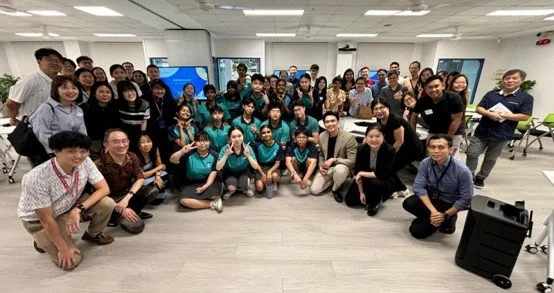
On the afternoon of 13 August 2026, over sixty educators and researchers gathered at Chua Chu Kang Secondary School for the Knowledge Building Community Network Learning (KBCNL) session. Hosted by Taiwanese visiting researcher Rayen, the event addressed a crucial question for the AI era. How do we help students become independent thinkers who create knowledge rather than just consume it?
The inspiration came from a March school visit to China. There, Singaporean educators saw classrooms filled with student-led questions. Returning home, Lead History Teacher Melvin Chan and his colleagues discussed how to build a uniquely Singaporean model of Knowledge Building (KB). They wanted a model focused on real classroom impact and student ownership.
Moving Beyond Rigid Procedures
The first keynote speaker, Andy Ng, a teaching fellow at the Centre for Research in Pedagogy and Practice (CRPP), challenged the heavy reliance on procedural acronyms. Classrooms are often dominated by templates like PEEL for writing, CER for science, or CPA for mathematics. While useful, Andy argued these pre-packaged steps often do the thinking for students, robbing them of cognitive effort.
Instead, Andy proposed a principle-based approach. He introduced the “BESIDE” framework to help teachers design activities that foster epistemic agency. This agency represents how proactively students direct their own knowledge construction.
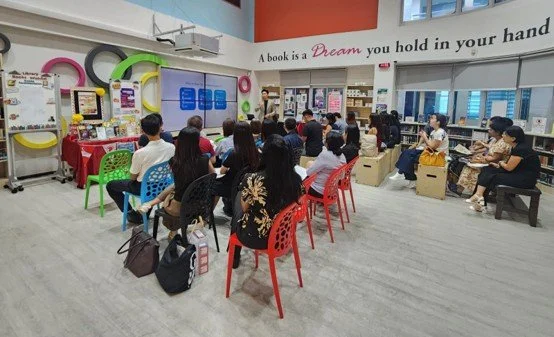
# Andy Ng explains the shift from rote procedural acronyms to student-led epistemic agency during his keynote.
Andy shared practical results from the recent “Knowledge Design Studio” programme, where students visited Mangan Gardens. Instead of memorising facts, they used sensory activation to develop inquiry questions. One group, noticing a scent, asked: "Why do some plants have similar smells?"
Using a “journey of thinking” scaffold with prompts like “I used to think... Now I understand...”, students tracked their progress daily. Their inquiry moved from basic biology into chemistry and memory psychology. They consulted biologists and the Nature Society director as co-investigators rather than passive lecturers.
Designing for the Real Classroom
Melvin Chan then took the stage. He shared how these principles can work inside daily school schedules. To make KB accessible, Melvin and his colleagues co-designed a simple school mantra: “Hear out, build on, rise above.”
At Chua Chu Kang Secondary School, students apply this mantra across different subjects. In mathematics, they tackled a real local issue: how to walk from the nearby MRT station to school in under five minutes. Rather than doing abstract textbook calculations, they built geometric and speed models to solve this actual problem.
To integrate AI naturally, Melvin introduced the “CRAFT” framework: Content, Response, AI and Peers, Fusion, and Reflect. Under this framework, students first read their text materials. They then design inquiry activities for their peers. Next, every student writes an initial personal response. After that, they receive feedback from classmates and interact with AI tools. Finally, students fuse these different perspectives together to improve their original ideas. They close by reflecting on their learning process and growth.
In this framework, AI serves as a partner. Students can ask the chatbot to take on a specific persona for a conversation. They can also generate alternative responses from multiple AI platforms. They can then compare and contrast these with their own writing. This encourages critical comparison rather than blind acceptance of AI output.
History Through Student Eyes
The afternoon also featured a live presentation by secondary school students. Joe and his teammate shared their history project. They studied the evolution of Singaporean transport from the colonial era to the modern day.
The students did not just list historical facts about bullock carts and rickshaws. Instead, they reimagined Singapore’s transport history through three creative themes. The first was “soaring”, which represented vertical achievements like HDB lifts. The second was “striking”, which examined historical labour struggles like the Hock Lee bus riots. The third was "shuttling", which explored daily commutes and the transition from civilian life to military service on Pulau Tekong.
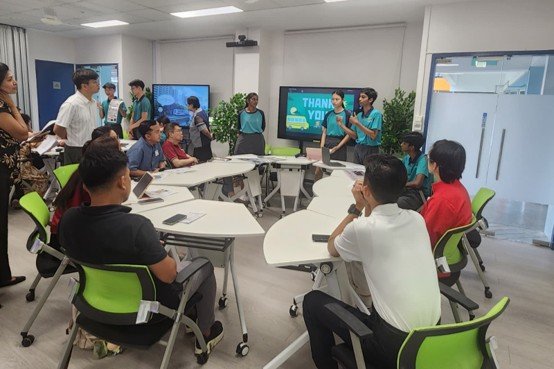
#Student presenter demonstrates how his team used the online Knowledge Forum to collaborate.
Joe explained that their team comprised students from different classes. They collaborated entirely online using the Knowledge Forum. Although finding a shared direction was challenging, they avoided major arguments. They did this by sticking to three core group values: “every individual is valuable, every idea is improvable, and every inquiry is doable.”
Hubert, a secondary school history teacher, noted that the online platform changed their classroom culture. Quieter students, who rarely spoke in class, became some of the most active contributors online. Their peers began to respect them as thought leaders. This showed how a safe digital environment can build confidence and mutual respect.
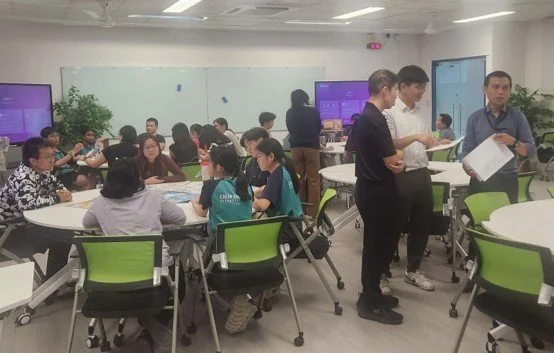
# Roundtable Discussion
Preparing Learners for an AI World
The event concluded with a panel discussion. It was facilitated by Dr Katherine, a research scientist from NIE. The panel included curriculum leader Jenny, Melvin Chan, Andy, and former KB student Ishra. Ishra is now a professional firefighter.
The panel addressed the common worry of managing syllabus constraints. Teacher Annabelle noted that while lower secondary classes offer room for exploration, upper secondary teachers face tight exam timelines. Melvin suggested that school leaders can support teachers by introducing “structured flexibility”. For example, schools could implement flexible schemes of work. Teachers would have a full month to meet baseline success criteria. This allows them to adjust the pacing with their students.
Jenny, who has twenty-five years of curriculum innovation experience, emphasised the need for "teacher flourishing." She argued that no teacher should be left behind. She suggested that schools establish clear baseline expectations. At the same time, they should allow ready teachers to push the boundaries of classroom practice.
As the session drew to a close, Melvin shared a final phrase that guides his teaching: “I am because we are.” In a world increasingly dominated by artificial intelligence, Dr Teo reminded the audience that our humanity is our greatest strength. If we do not give students the space to own their thinking today, they will simply outsource their thoughts to AI tomorrow. Giving students agency is not just a teaching method. It is how we prepare them to remain human in the future.
Overall, the learning session at Chua Chu Kang Secondary School highlighted a promising path forward for Singaporean education. By shifting from rigid procedures to active knowledge building, classrooms can become spaces of genuine discovery. The journey of these educators, researchers, and students shows that when we trust young people with their own learning, they do not just meet expectations. They rise above them. As this community network continues to grow, it is clear that the future of learning in Singapore lies in the collective power of human ideas.
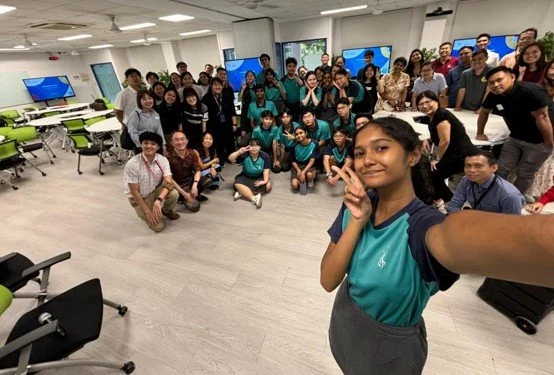
# The day wrapped up beautifully as the students gathered for a final group photograph.