

The journey of a thousand li begins with a single step. Our aim is to chronicle every step we take as our community matures in honesty, humility and truth.
A lofty goal perhaps, and one we'll pursue together.
Someday, your story will appear here!
Creating Idea-corners at Home for Knowledge Building by Dr Teo Chew Lee
As part of OER Education at Home series, Dr. Teo Chew Lee has created a video about the creation of idea-corners at home for knowledge building, especially during periods of Home-Based Learning in Singapore. You can view the embedded video on this page or at this link.

Dr. Teo Chew Lee from NIE, NTU, Singapore

Teck Whye Secondary School KB Newsletter
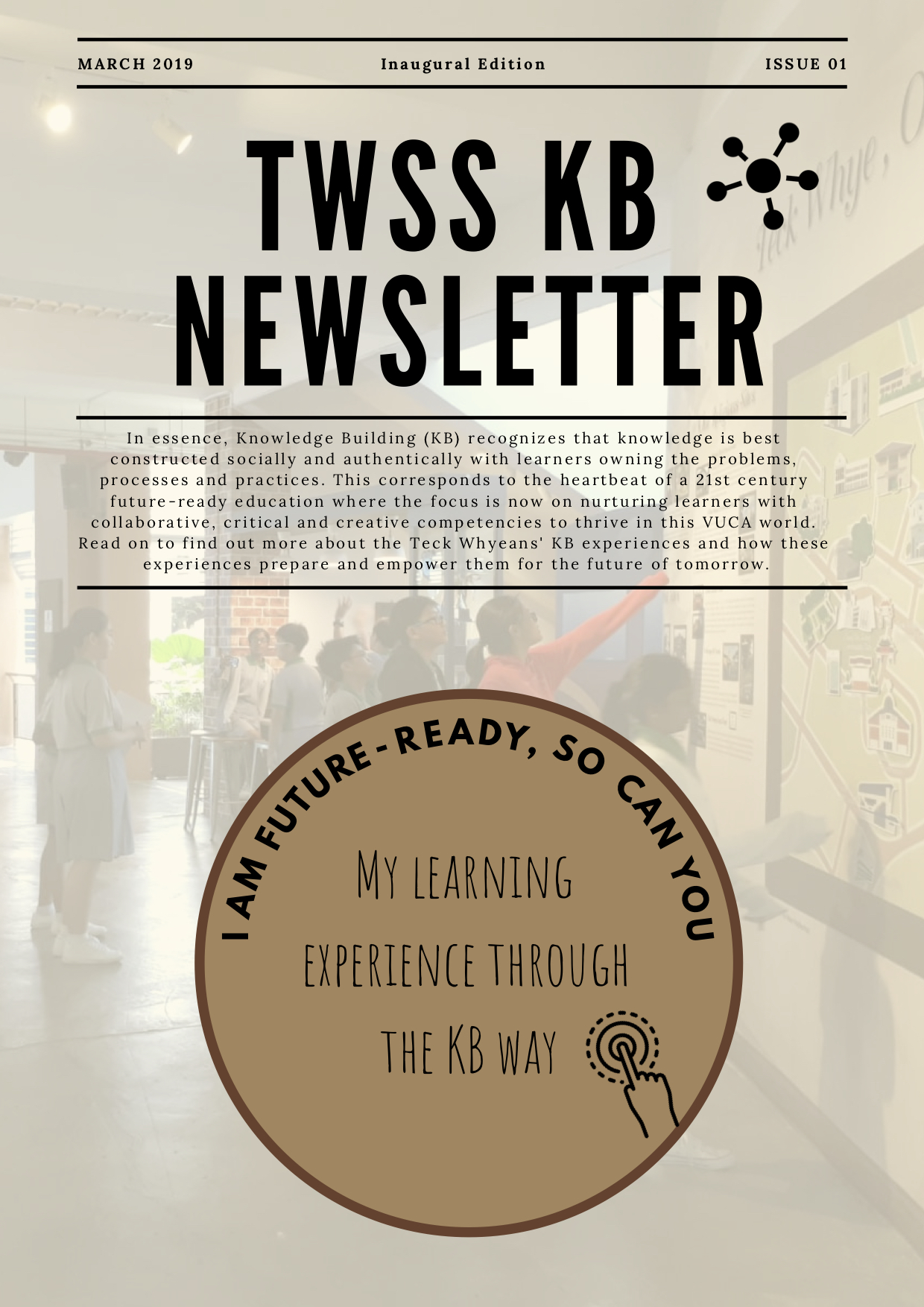
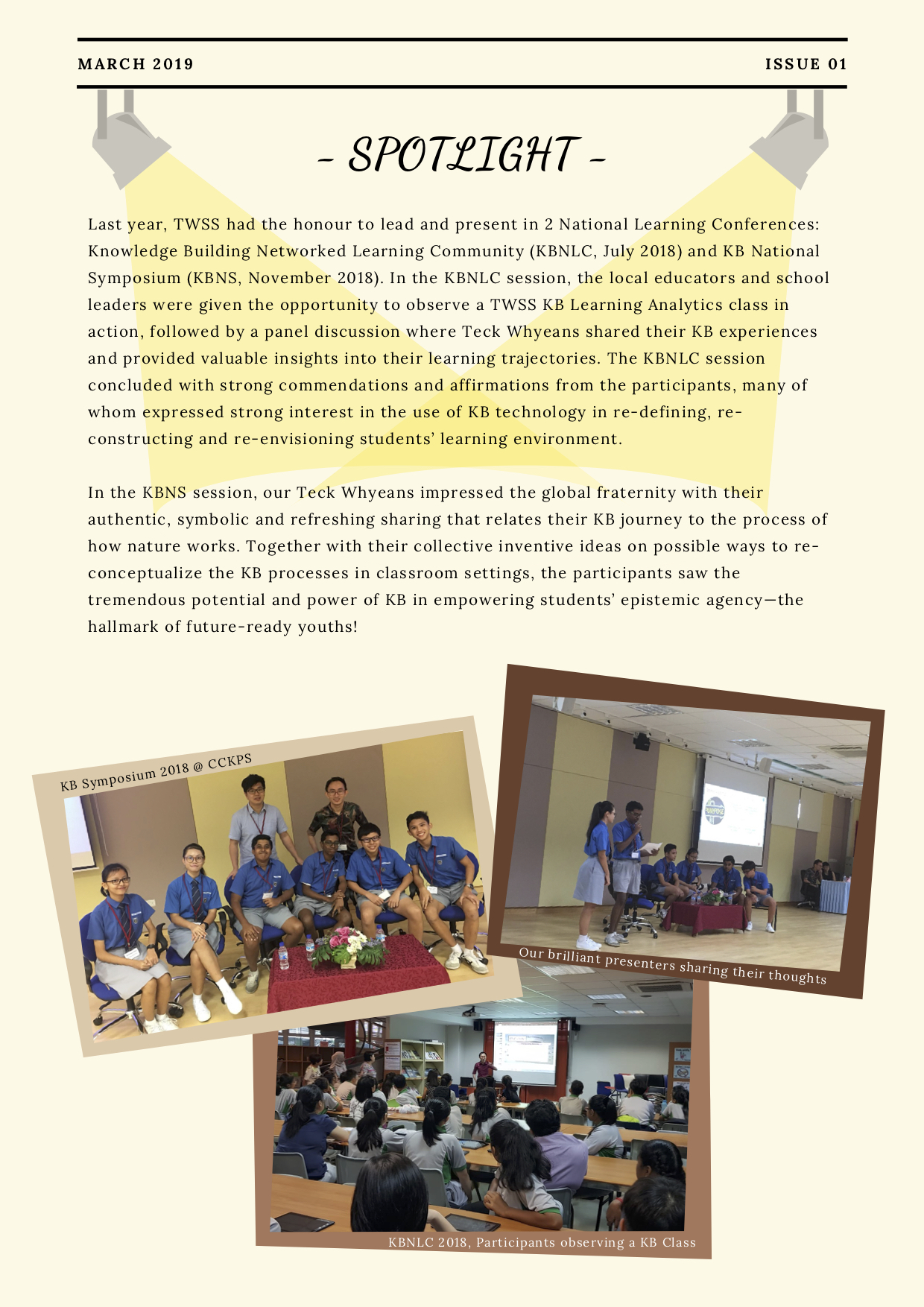
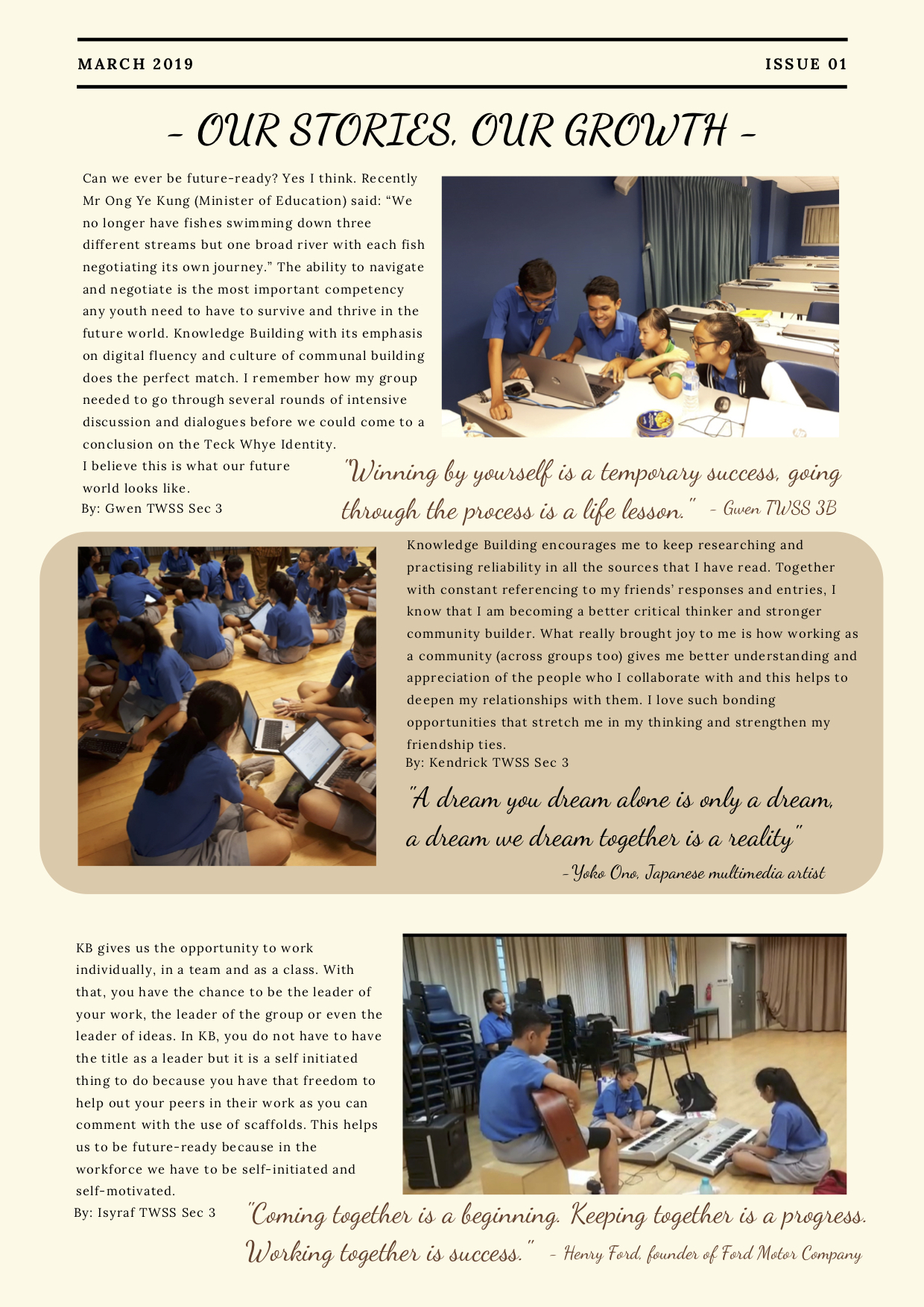
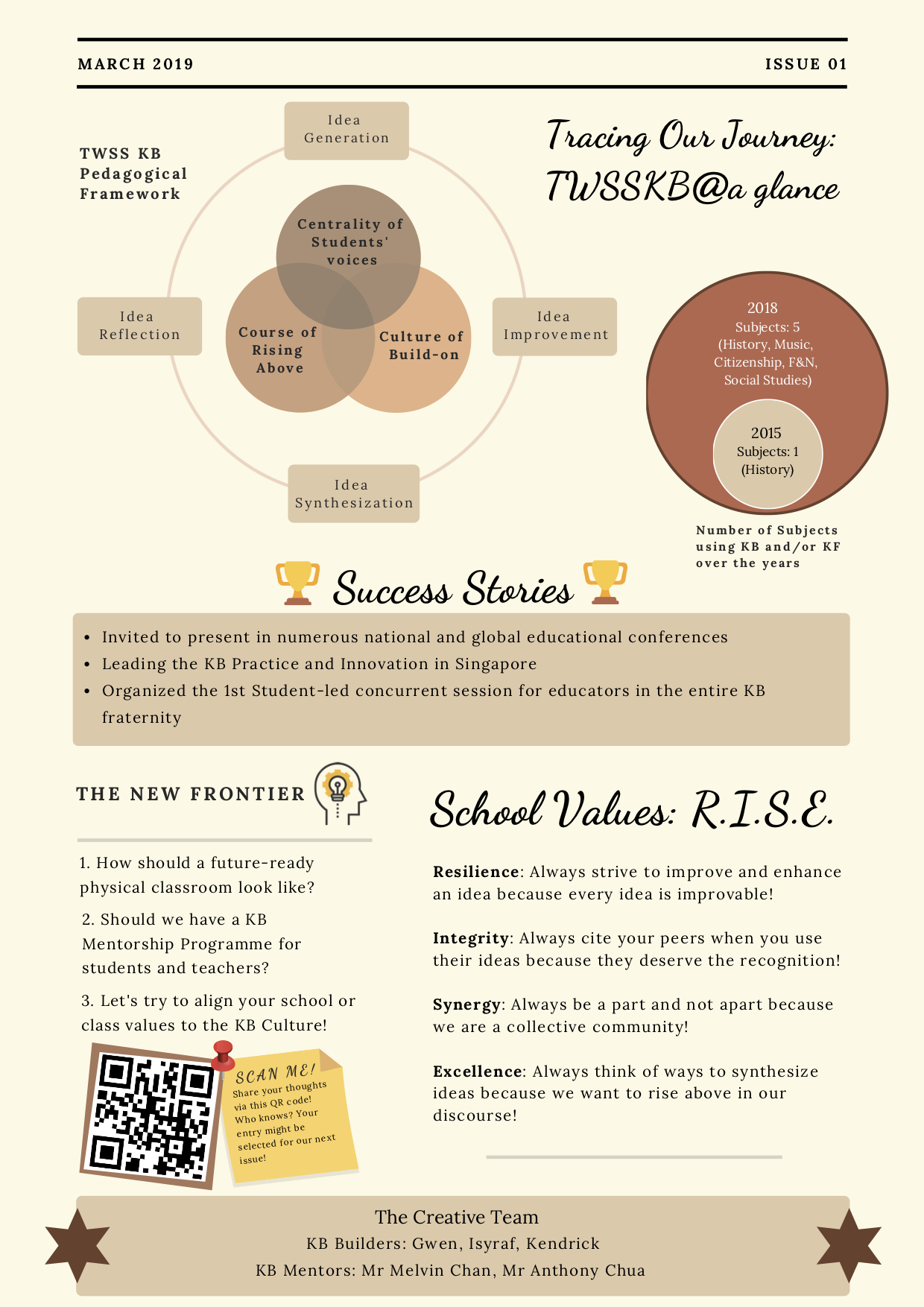
The KB team from Teck Whye Secondary School released their inaugural KB newsletter for March 2019. Stay tuned for their Issue 02 of their newsletter.

Students' Voice: Reflections on KB Symposium 2018
Students’ reflections on their experience and their learning from the KB National Symposium 2018
Zachery
“I think that Knowledge Forum is not just a platform where we use for history and music only. It is a perfect platform where it can be used in many subjects. For example, Literature. I am amazed at how Knowledge Building can help us grow in Literature by building on each other ideas and understanding of certain phases or character analysis. Personally, I hope to see Knowledge Forum and Knowledge Building in polytechnics and working place. For example, this is a good opportunity for adults to discuss, build on and improve on their ideas. This wil help the project to become better and stronger.
I have been to 2 KB symposium. Everytime I attend, I learnt and shared new things. For example, this year we used the idea of nature to relate to our presentation. Nature always represent growth and nature also means authentic. We come to this idea after building and sharing knowledge with each other. We hoped to share to the audience that Knowledge building in a classroom is something refreshing, just like how nature works.
I think that the entire experience was incredible. It is very different to present in front of so many teachers from so many different schools. But I think we done well in terms of project our voice and responses to questions from the audience. I think this is because of our Knowledge Building lessons makes us always ready to think and respond in a deep and fast manner. “
Syafiqah
“The symposium was quite foreign and new experience for me. I have never presented in front to so many people. This sharing helps me to become even more confident. I was actually amazed at how my friends and myself are able to response to the questions from the audience swiftly. I feel that I am thankful we are the only students who shared so in depth throughout the symposium. Our sharing is not just about our experience but also our thoughts on why Mr Melvin Chan designed the Knowledge Building lessons in this format. This gives us a voice. I was actually happy that we have this chance to share our thoughts and ideas.
This symposium shows to me that Knowledge Building really builds a classroom that is student lead and not teacher lead. Besides our school, other schools’ sharing also show that. I hope that other schools can used this too. Students actually get to learn more and also learn from each other. My personal experience in Teck Whye Secondary School History lessons shows to me that there will always be friends who can clear my wrong understanding in Knowledge Forum and entries that we can take reference from. I think this is what a classroom should look like. “
Marsya
“This was my first time participating in a Knowledge Forum Symposium. I realised that this symposium was for everyone, not just teachers but also students. This symposium shows to me that knowledge is best created when we work together as a group or even better, as a class. I love the part where other teachers are amazed at Teck Whye Secondary School Knowledge Building lessons, especially when we share our thoughts and Mr Melvin Chan shared the framework and process of creating Knowledge Building classrooms. I look forward to us sharing more next year with new ideas and improvise current ideas.
I would describe Knowledge Building and Knowledge Forum as a lifesaver. Besides saving us from less exciting lessons, Knowledge building trains us to be ready for the future. We learn how to work together by sharing information, asking questions and giving diverse ideas. We also learn how to think and reflect. These are the lifesaving skills that we need in the future.”
Kishen
“I was particularly encouraged when a few teachers complimented us for the symposium. Some of the compliments include: All of you are so confident, Going through 9 months is so tough and yet all of you persevere and emerge stronger in your knowledge of History, Music and Citizenship, and Great job! Love to see how you shared your views and thoughts of how KB can be applied in the future.
I would love to connect with the international schools, just like how we connected with the Canadian schools next year. I think that this is what Knowledge Building is all about. Working with more international schools will help us learn more about other culture and maybe this can help us create a better solution as a world.
For my juniors, I would recommend all of you to join this symposium as presenter. It will increase your confidence as a student. It will also make you proud to be a Teck Whye student where other teachers are learning from us.”
Keynote at CSCL 2017
Dr. Teo Chew Lee was invited to be a keynote speaker at CSCL2017.
The 12th International Conference on Computer-supported Collaborative Learning (CSCL) was held in Philadelphia, Pennsylvania from June 18-22, 2017.
Dr Teo Chew Lee, a Senior Research Scientist at NIE who leads the KB community and KB work in Singapore, was the keynote speaker at this conference. In her speech, she traced the growth of four dimensions of an 8-year KB project in Singapore classrooms: (i) growth in number and connectedness of teachers in practice; (ii) growth in the dimensions of teaching and learning involved in the innovation; (iii) growth in ownership of practice; (iv) growth in research considerations; (v) growth in the role of the researcher. She discussed the fact that a detailed study of these areas of growth is warranted in order to ensure symmetry in advancement in all stakeholders in schools and consider all dimensions of schools and teaching and learning processes.
For more information on CSCL 2017, please visit https://www.isls.org/cscl/2017/cscl17.wordpress.com/index.html
KB Symposium 2016: KB as Students
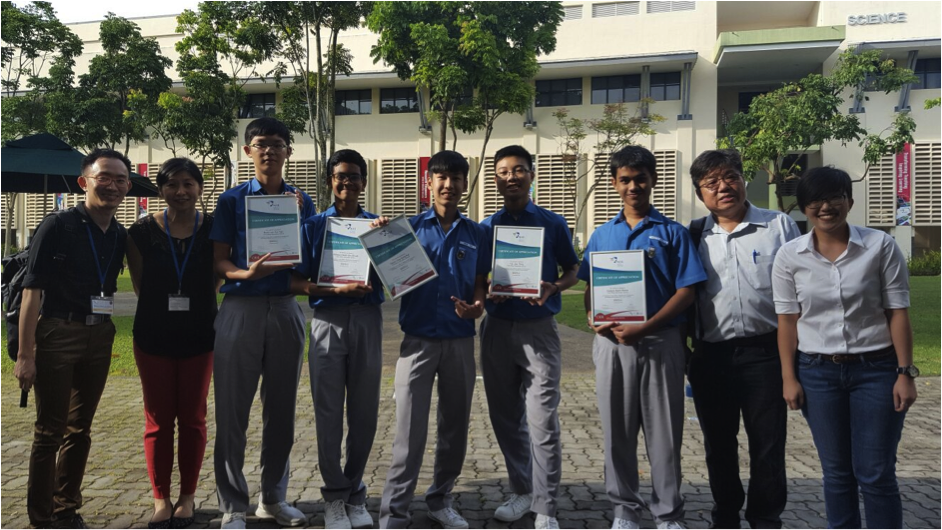
Teck Whye Secondary School (TWSS)'s student presenters and their teachers.
On the 21st of November, the first local Knowledge Building (KB) Symposium, "Ideas First, A Reason to Teach" was held at the National Institute of Education, gathering members of the KB community locally as well as from Hong Kong and Quebec to share about their experiences.
Amongst those present were a group of 5 students from Teck Whye Secondary School, the sole student representatives amidst teachers and KB practitioners attending the symposium. All eyes were drawn to them as they stepped up to share about their experiences with the Knowledge Forum (KF), as well as to enact a short skit on how knowledge building had been conducted in their History class.
Despite the initial nervousness from having teachers as their audience, the presentation ran ahead without a hitch and were met with a round of applause for the informative and creative skit.
“Even though we had only short time to prepare our skit, but it was worth it when some teachers mentioned that they benefitted from the presentation and the skit. ”
Aside from the students' presentation, keynote speakers Professor Nancy Law and Professor Therese Lafarriere also took to the stage to share on their extensive educational research in their respective countries, Hong Kong and Quebec. This was followed by round-table discussions on the KB practice locally, as well as a hands-on experience with the newest version of the Knowledge Forum, KF6, before wrapping up with a short workshop for teachers on working with students' ideas.
Reflecting upon the event, one of the students, Ryan, expressed,
“The KB Symposium was an eye opener for me as formally, I did not know the huge size of the Knowledge Building Community. ”
The students also reflected that participating in the event had broadened their perspectives on the application of knowledge building in the classroom beyond History itself.
“I learnt that Knowledge Building can be applied to primary school where children can become innovative in generating sensible questions.”
“I found the workshop regarding the knowledge building principles interesting as I could see how knowledge building could be implemented into other study disciplines other than humanities itself. On the whole, I feel that knowledge building is very useful especially in humanities as it really helps to stretch our brains and thinking further. It allows connection and enhancement of the ideas through Knowledge Forum that ignite the concept of knowledge building. ”
With the success of the first symposium, we would like to thank all who have participated and contributed to the event. We look forward to subsequent editions of KB symposiums, and to seeing the KB community grow as we strive to further develop knowledge building in Singapore.

History and KB: The Perfect Combination
As a practitioner who believes that history must be taught as a discipline, it is vital that my students see the necessity and beauty of History. Knowledge Building lends itself well in helping me to create history lessons that align to the vision and philosophy which I hold dear to.
Without History, we will cease to exist.
Commonly held by people, History is but a matter of knowing the factual information of the past. Indeed, this is part of history. However, it would be a pity should one grow up with this notion in mind. History would have lost its purpose, meaning and significance. This is simply because history transcends beyond this mere boundary.
As a practitioner who believes that history must be taught as a discipline, it is vital that my students see the necessity and beauty of History. Beyond having knowledge of historical content, I would hope that my students will come to the realization that history is the force that forms their core identity, the ground that establishes their underlying beliefs and most importantly of all, the catalyst that prepares them well for their future.
Knowledge Building—and its technological tool Knowledge Forum—lends itself well in helping me to create history lessons that align to the above vision and philosophy which I held dear to. Through its scaffolds and principles-based approach, history lessons become one that embraces diversity of viewpoints, empowers empathetic and inventive thinking and not forgetting enhancing students’ collaborative and cooperative learning experiences.
How then do I design my history lessons with the use of Knowledge Building?
Briefly, there are 3 main areas that I will pay great attention to. First, students’ ideas will always be placed at the forefront of the lessons, exactly like how a historian starts his investigation. This meant that there is democratization of knowledge where lessons will run according to students’ questions, interests, curiosities and sometimes even on the personal experiences of the students. Following closely to that is the element of build-on where participants would provide new information and/or other perspectives to the inquiry questions or ideas to broaden ones’ understanding and perhaps sometimes, to clear possible misconceptions to these issues. Last but not least, just like any piece of historical work, students will need to consolidate and develop an enhanced theoretical understanding through the incorporation of considerations raised by others. Besides training them to be historians-in-practice, wouldn’t this form of history education prepare them well with the competencies ready for the 21st century workforce?
Just like how I have used Knowledge Building as the framework and pedagogy for my history lessons, my colleagues and myself are constantly being Knowledge Builders too so that we can further enhance on the teaching and learning of History in our classrooms!
Eds: Melvin received the Outstanding Youth in Education Award. Learn how he uses K-pop to teach students about World War II here.