
Beyond the Theory: Reflections on Epistemic Agency in Knowledge Building
By Rayen Chang
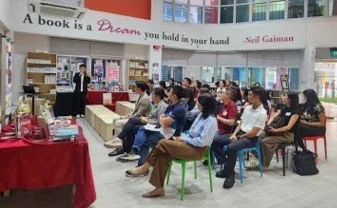
As a visiting researcher from National Chengchi University (NCCU) in Taiwan, my time at the Centre for Research in Pedagogy and Practice (CRPP) has been a rich journey of academic dialogue. Throughout my stay in Singapore, I have engaged in various research meetings, discussions with local scholars, and seminars on progressive pedagogy. Alongside these academic dialogues, on 13 August 2026, I attended the Knowledge Building Community Network Learning (KBCNL) activity at Chua Chu Kang Secondary School. In academic discourse, we often discuss epistemic agency in abstract terms, analysing how to transfer cognitive control to learners. However, witnessing this theory translate into classroom practice during my visit offered a profoundly different perspective. At the school, it became clear that the guiding philosophy of “Hear out, build on, rise above” is far more than a passive slogan on a wall; it is a living, breathing culture.
This collaborative culture was immediately apparent during the roundtable discussions, where I had the privilege of sitting alongside secondary school students, classroom teachers, and university researchers. These conversations mirrored the horizontal collaboration that remains central to active educational research, where researchers and practitioners engage as equals. Together, we listened to students share their historical research, not as passive subjects reciting memorised facts, but as active creators of knowledge. The subsequent dialogues around the tables felt entirely horizontal. The session was guided by the clear principle that every student is a valuable contributor and every idea is inherently improvable. Observing this level of mutual respect demonstrated how a safe, digital environment like the Knowledge Forum can fundamentally restructure classroom dynamics.
This experience also prompted a deeper reflection on the role of education in an era increasingly defined by artificial intelligence. A particularly compelling moment during the panel discussion featured Isyraf, a former Knowledge Building student who now serves as a professional firefighter. He described how the inquiry skills cultivated in Melvin Chan’s history classroom remain vital to his daily work, particularly when adapting international rescue tactics to local emergencies. His testimony underscores the true stakes of modern pedagogy. If we do not provide students with the intellectual autonomy to navigate complex, unstructured problems today, we risk raising a generation that simply outsources its thinking to AI platforms tomorrow.
Finally, my entire visiting research term has been profoundly shaped by these multifaceted connections between theory and practice. The KBCNL activity served as a vivid highlight of a broader educational philosophy that prioritises the collective growth of ideas, a concept that has been a recurring theme throughout my stay. I am deeply grateful to the Singaporean educational community for welcoming me into their spaces of research. The diverse insights gathered during this visiting stint will undoubtedly enrich my ongoing academic work in Taiwan. This journey has offered undeniable proof that when we entrust students with the collective responsibility of constructing knowledge, they do not merely meet our expectations but rather rise far above them.